The Magic of a Fairy Tale Bedtime Story
Read an original fairy tale about a lost garden key, then adapt it for your child. Find simple story ideas, retelling tips, and a personalized story prompt.
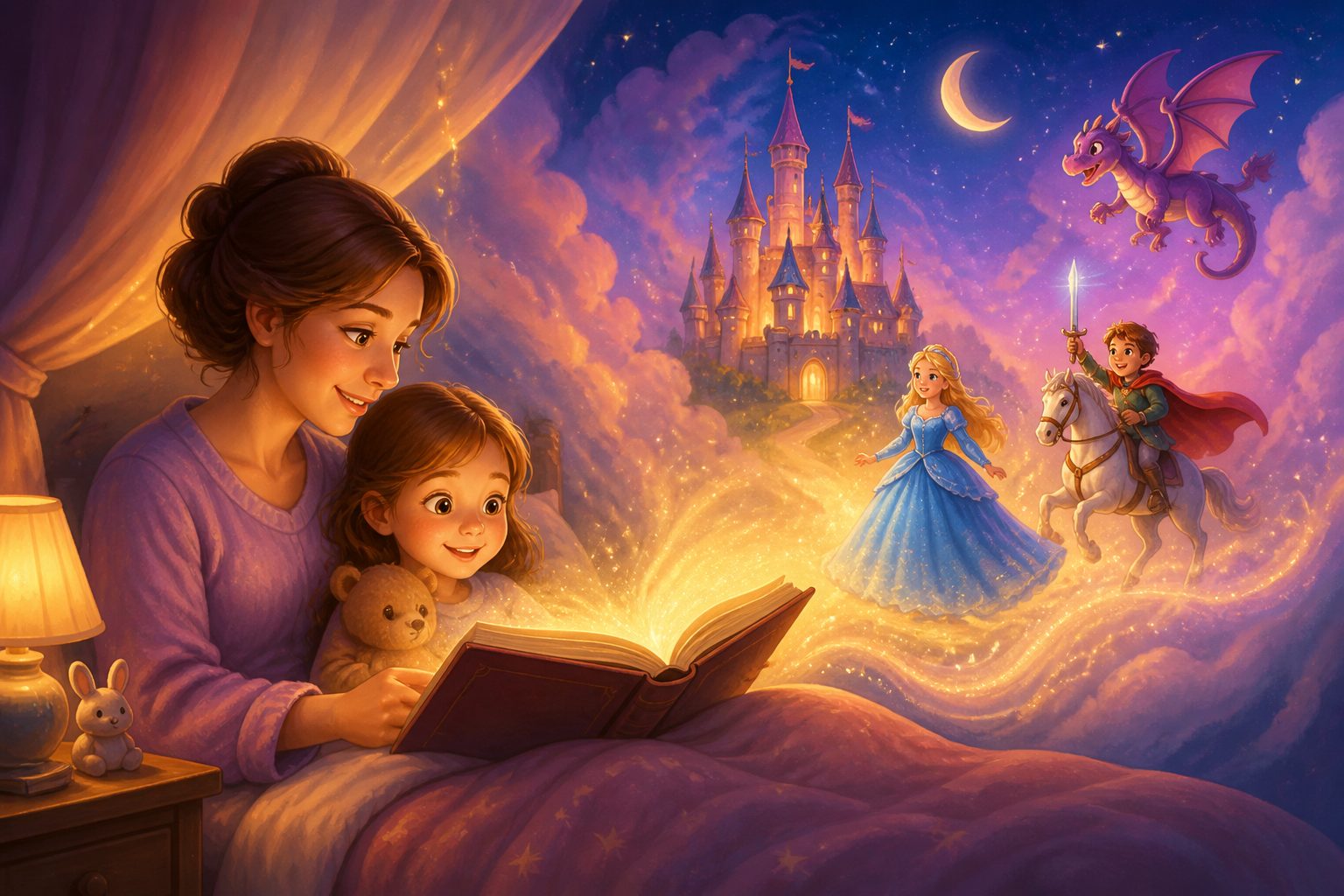
A fairy tale bedtime story can contain a little magic without a frightening chase or a battle. A door that opens onto a moonlit garden, a helpful creature, and a small task are enough to build an adventure with a satisfying ending.
At a glance: Read the original tale below, shorten the journey if you need to, or adapt it around your child's favorite object. Choose a version your listener enjoys; a gentle story is an evening reading choice, not a promise of sleep.
Read aloud: The Keeper of the Evening Key
Once upon a time, a child named Rowan lived beside a garden with a blue wooden gate. In the morning, the gate opened onto ordinary flowers. In the evening, it sometimes opened onto somewhere else.
One night, Rowan found a small brass key on the doorstep. A paper tag was tied to it with green thread.
“Please return before the last bell,” the tag said. “The garden keeper has misplaced it.”
Rowan put on a cardigan and opened the gate. Beyond it stood a path of pale stones, each one shining just enough to show the next.
At the first bend, a hedgehog sat beside a wheelbarrow of empty flowerpots.
“Are you the garden keeper?” Rowan asked.
“No,” said the hedgehog. “I look after the pots. But I can show you the way to the fountain.”
He pointed with a little wooden spade. Rowan thanked him and followed the path.
At the fountain, water trickled into three shallow bowls. A moth rested on the largest bowl, wearing a hat no bigger than a pea.
“Are you the garden keeper?” Rowan asked.
“No,” said the moth. “I look after the evening invitations. But the keeper is usually near the silver greenhouse.”
She lifted one wing toward a glass building at the end of the path.
Inside the greenhouse, a fairy named Vela was counting folded blankets. She counted them once, then again.
“Three for the benches, two for the chairs, and one for the cat,” she said. “Everything is ready except the last cupboard.”
Rowan held out the key. “Is this yours?”
Vela smiled. “There it is. I set it down when I carried the watering can to your doorstep. Thank you for bringing it back.”
The cupboard was tall and narrow. Rowan expected a treasure chest, or perhaps a shining crown. Instead, Vela opened the door to reveal rows of tiny watering cans.
“Even magic gardens need ordinary care,” she said.
Together they chose one can. Vela watered the flowers beside the greenhouse while Rowan watered a small fern by the door. Then they returned the can, closed the cupboard, and hung the key on its hook.
A bell sounded once from the garden wall.
“The last bell,” said Vela. “Time to finish.”
She walked Rowan to the fountain, where the moth had put away her invitations. At the bend, the hedgehog's flowerpots stood in tidy rows. Beyond them, the blue gate waited.
Rowan stepped through into the familiar garden. The flowers were ordinary flowers again. The pale stones were simply stones.
From the house came a voice: “Ready for your goodnight?”
Rowan closed the gate and went inside. The cardigan was hung on its peg. The slippers were placed beside the bed.
Outside, the garden was quiet. Somewhere beyond the blue gate, a brass key rested safely on its hook.
Make the tale your own
Change a few details while keeping the clear task: find the key's owner, return it, and go home. Your child can be Rowan, the garden can become a courtyard, and the cardigan can become a favorite sweater.
For a shorter telling, go straight from the gate to Vela's greenhouse. For a longer telling, add one helpful character who gives a clear direction. Avoid adding a new mystery on the last page if you want the story to feel finished.
You can also invite one choice before you begin: “Should the gate be blue or green?” That gives your child a part in the story without turning every sentence into a decision.
Choosing a familiar fairy tale for bedtime
Read the particular version before sharing it. Different retellings of the same fairy tale can include very different scenes. If a wolf, a threat, or a separation worries your listener, choose another version or tell them what happens before reading.
When adapting a tale aloud, keep the change easy to follow. A giant who has misplaced his slippers needs help finding them; a giant who threatens the village creates a very different story. You can preserve the magical setting while giving the characters a smaller problem.
You do not need to remove every challenge. A missing object, a mistaken direction, or a job that needs two helpers can make a story interesting without making danger its central feature.
Two more fairy tale starting points
The cloak with an empty pocket: A traveler finds that a magical cloak has room for one kind deed. They help a neighbor carry a basket, and the pocket fills with a single paper star. At home, they place the star above their bed.
The castle's smallest room: A royal gardener tries several grand rooms for a visiting field mouse. The mouse chooses a little room beside the garden instead. Together they furnish it with a leaf curtain, a seed box, and a comfortable chair.
Give each idea one task and one ending. A fairy tale does not need a moral announced at the end; the characters' choices can carry the meaning.
Create an illustrated fairy tale
Start a personalized fairy tale with this prompt:
Write an original fairy tale about [name] returning a small brass key to a friendly garden keeper. Use a magical garden, two helpful creatures, and a clear journey home. Include [favorite clothing or object]. Keep the dialogue simple, avoid threats and chases, and finish the task before the final goodnight.
Storywish creates text and illustrations from your ideas. Use the character guide, then review the entire result before sharing it. Check that the pictures match the tone as well as the words. A digital story can also become a printed softcover book.
Frequently asked questions
How long should I read?
Choose the amount that suits your evening and your child. You can read one short tale, stop at a natural break in a longer book, or reread a familiar favorite. There is no single ideal length for every listener.
Does a fairy tale need a prince or princess?
No. A gardener, child, shoemaker, or animal can be the main character. What matters is a clear wish or task and an ending that answers it.
What if my child wants a more exciting tale?
Follow their interests and consider when to share it. You can keep a lively adventure for another reading time and offer a familiar story in the evening.
Want to make your own personalized AI children's story? Try Storywish free.
Related posts

The Magic of a Snowman Bedtime Story
September 10, 2026 · Read an original snowman bedtime story about choosing a name. Find winter plot ideas, simple ways to personalize the tale, and a prompt for a keepsake book.
Tooth Fairy Bedtime Story: A Magical Guide for Parents
September 07, 2026 · Read a gentle tooth fairy story about a tiny letter. Adapt the tradition for your family, explore story ideas, or create a personalized milestone keepsake.
Unicorn Bedtime Story: Lumina and the Sunset Ribbon
September 09, 2026 · Read a gentle unicorn tale about a magical sunset ribbon. Explore five story prompts, simple adaptations, and ideas for a personalized illustrated story.

Whale Bedtime Story: Nori and the Returning Note
September 09, 2026 · Read an original whale bedtime story about an echo in a quiet bay. Explore ocean plot ideas, a simple whale fact, and a prompt for your own illustrated tale.