Whale Bedtime Story: Nori and the Returning Note
Read an original whale bedtime story about an echo in a quiet bay. Explore ocean plot ideas, a simple whale fact, and a prompt for your own illustrated tale.
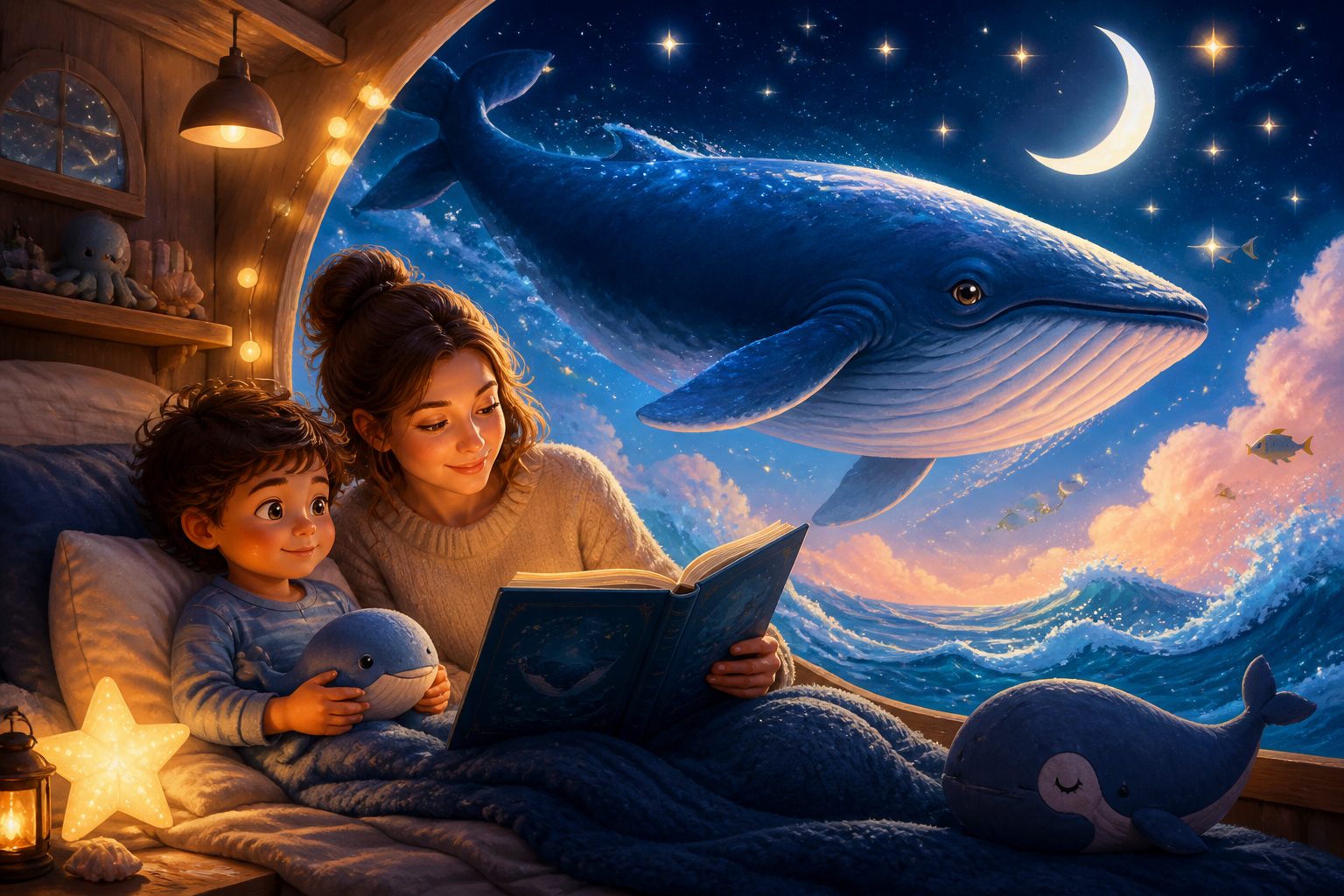
A whale bedtime story can open with a wide ocean and follow one small discovery. In the original tale below, a young whale learns that an echo is not another animal answering from the rocks.
At a glance: Read “Nori and the Returning Note,” try two more ocean plots, or create your own illustrated adventure. The story uses talking animals and an invented bay; its ending resolves the whale's question.
Read aloud: Nori and the Returning Note
Nori was a young whale with a question for every journey. Why did the water look green near the shore? Which way did the gulls go when they left the bay? How many smooth stones lay beneath the waves?
His mother, Selka, answered some questions. Others they saved for another day.
One evening, they reached a quiet curve of the coast. Nori rose to the surface for air, then looked toward the rocks.
“Hello,” he called in this story's whale language.
A moment later, a faint sound returned.
Nori listened. “Someone is saying hello.”
He called again, this time with a longer note. The longer note came back too.
“Do they know my song?” he asked.
Selka came beside him. “Try one short sound, then listen.”
Nori made a short note. He waited. A short note returned from the rocky side of the bay.
“Now try two,” Selka said.
Nori made two little notes with a space between them. Two little notes came back, with the same space between.
“They copy everything,” he said.
“That's an echo,” Selka replied. “A sound can bounce back from a surface. You are hearing your own note return.”
Nori considered this. He had expected a new friend hiding near the rocks. Instead, he had found something his own voice could do.
“Is an echo always there?” he asked.
“Not everywhere in the same way,” said Selka. “Tonight, we noticed one here.”
Nori sent one last note toward the rocks. He waited for its return, then let the bay become quiet again.
On their way out, they surfaced together. The first star was above the headland.
Nori looked back. “Goodbye, echo,” he said softly. He did not wait for an answer this time.
Selka followed the familiar route beyond the point. Nori stayed beside her, thinking about his question and its answer.
He had not found another whale at the rocks. He had found a returning note. That was enough of a discovery for one evening.
Keep a little ocean fact beside the fantasy
The dialogue and family conversation are invented. One real detail worth keeping is that whales breathe air and return to the surface to breathe. NOAA's Whale Anatomy resource explains whale anatomy for curious readers.
If you make up an underwater adventure, show a whale surfacing rather than breathing underwater. Give a human character a clearly magical bubble if they join a fantasy, or keep them on shore in a realistic version.
The echo in Nori's tale is a simple story device, not a guide to how every whale species communicates. You can keep factual questions separate from the invented conversations.
Two more whale story ideas
The picture from the shore
A child sketches a whale they imagine beyond a headland. They try several shapes, choose one they like, and place the drawing beside a favorite ocean book. Tell the story from the child's viewpoint, with the whale remaining part of their imagination.
The three landmarks
A whale and a companion follow an invented route past a tall rock, a sandy cove, and an island shaped like a hat. Each landmark marks one part of the journey. End when they reach their destination, with no new trip announced on the last page.
For a shorter story, use two landmarks. For a reader who likes world-building, let them name the island and describe its shape.
Read at a comfortable pace
Pause after Nori asks a question so the dialogue stays clear. You do not need to imitate whale calls, stretch every word, or lead a breathing exercise. A normal read-aloud voice can carry the tale.
If your child wants to talk about echoes, follow the conversation. If they prefer to listen, keep the story moving. Choose the amount of reading that suits the evening rather than a fixed duration for all children.
Create a personalized ocean adventure
Start your own whale story with this prompt:
Write a short illustrated ocean story about a whale named [name] who notices [small discovery] while traveling with a friendly companion. Use an invented bay with [two landmarks]. Include surfacing to breathe, keep animal dialogue clearly fictional, and finish with the question answered and the journey complete.
Use the character creation guide to shape your cast. Review the generated story and illustrations, especially any wildlife facts. Read digitally or preview a softcover printed keepsake.
Frequently asked questions
Does an ocean story need a scary depth or a storm?
No. A shoreline, a question, or a familiar route can supply enough detail for an interesting plot.
Can a younger child enjoy this tale?
You can shorten the dialogue and keep the two-note echo sequence. Follow your child's interest rather than assuming every child of one age needs the same version.
Are whale stories proven to help children sleep?
This article offers fiction to share, not evidence for a sleep effect. Choose an ocean story if your child enjoys the setting and the time reading together.
Want to make your own personalized AI children's story? Try Storywish free.
Make it a story
Related posts

The Magic of a Snowman Bedtime Story
September 10, 2026 · Read an original snowman bedtime story about choosing a name. Find winter plot ideas, simple ways to personalize the tale, and a prompt for a keepsake book.
Unicorn Bedtime Story: Lumina and the Sunset Ribbon
September 09, 2026 · Read a gentle unicorn tale about a magical sunset ribbon. Explore five story prompts, simple adaptations, and ideas for a personalized illustrated story.
Tooth Fairy Bedtime Story: A Magical Guide for Parents
September 07, 2026 · Read a gentle tooth fairy story about a tiny letter. Adapt the tradition for your family, explore story ideas, or create a personalized milestone keepsake.
Tiger Bedtime Story: Taran's Rainy Evening
September 07, 2026 · Read an original tiger bedtime story about a rainy evening. Find gentle plot ideas, reading options, and a prompt to create your own illustrated tiger tale.