Raccoon Bedtime Story: Moss and the Moon in the Pond
Read an original raccoon bedtime story about a moonlit pond. Find three woodland story ideas, ways to adapt the tale, and a personalized mystery prompt.
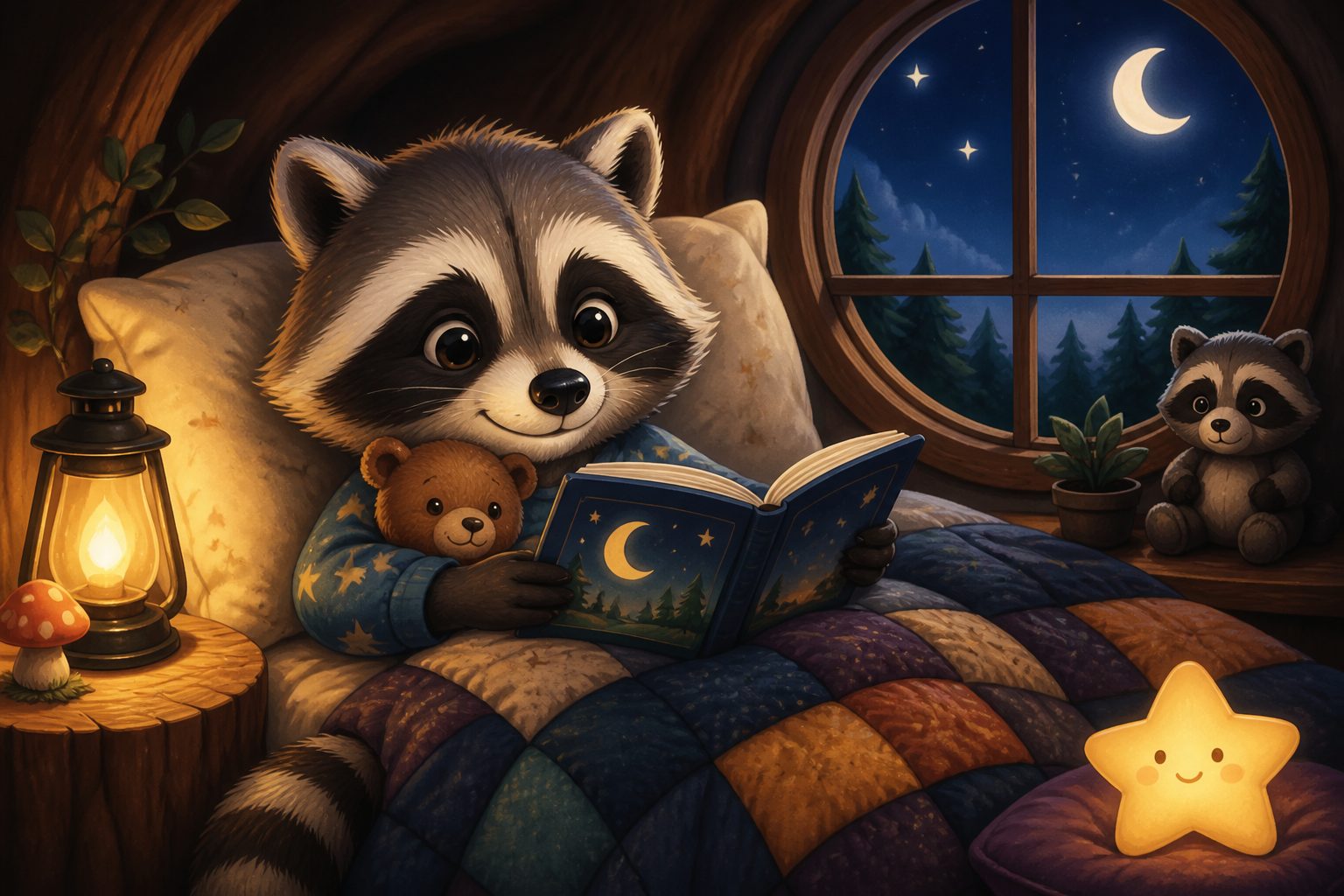
A raccoon bedtime story can be a small woodland mystery: a curious character notices something, asks a question, and discovers an answer. In the original tale below, the mystery is a silver circle that seems to have fallen into a pond.
At a glance: Read “Moss and the Moon in the Pond,” use one of the three story ideas, or create a personalized version. The talking raccoon is a fictional character; the story is for shared reading rather than a treatment for bedtime worries.
Read aloud: Moss and the Moon in the Pond
Moss the raccoon had a notebook with a green cover. On its first page, he had written a question: “Where does the moon go when clouds cover it?”
He had not yet found an answer he liked.
One evening, Moss walked to the pond with his older sister, Fern. A round silver shape shone on the water.
“There it is!” Moss said. “The moon has come down for a swim.”
Fern looked at the pond. Then she looked up.
“Before we decide,” she said, “let's look in two places.”
Moss tipped his head back. Above the trees, the moon was still in the sky. Below the trees, another moon shimmered on the pond.
“Two moons?” he asked.
“One moon, and its reflection,” said Fern. “The water shows us an image of the moon above.”
Moss sat on a flat stone. He watched a little ripple cross the water. The silver circle stretched, broke into bright pieces, and became round again.
“If the picture changes,” Moss asked, “does the real moon change too?”
Fern pointed upward. The moon looked just as round as before.
Moss opened his notebook. He drew a circle at the top of a page and another at the bottom. Between them he drew a wavy line for the pond.
A cloud moved over the treetops. Slowly it covered the moon. The silver circle on the water faded.
Moss looked up. He looked down. Then he waited.
The cloud moved on. The moon appeared again, and so did its reflection.
“It didn't go swimming,” Moss said. “We just couldn't see it for a little while.”
He turned to the first page of his notebook and added an answer beneath his question: “The moon is still there when a cloud passes in front of it.”
Fern peered at the page. “Will that do?”
Moss nodded. “For tonight.”
On the way home, they passed a puddle beside the path. A tiny silver shape shone in it too.
Moss smiled. “Another picture,” he said. He did not need to stop and solve the mystery again.
At home, he set the notebook on a shelf, open to the drawing of the pond. Fern hung their little lantern beside the door.
Outside, a cloud crossed the sky. Moss knew the moon would still be there when it passed.
Three more raccoon story ideas
The leaf with the unusual shape
A raccoon finds a leaf that looks like a mitten. They compare it with leaves along a familiar path and find the tree it came from. The ending is a drawing of the tree in a notebook, rather than taking every leaf home.
The borrowed button
A storybook raccoon borrows a wooden button to decorate a paper crown. When the crown is finished, they realize the button belongs on a friend's coat. They return it and make a new crown decoration from paper.
A name for the little bridge
Two raccoon friends have different names for the same bridge. One calls it Pebble Bridge; the other calls it Fern Bridge. They discover that both names describe something nearby and agree that either name will do.
Each idea contains a question or a choice rather than a threat. Give your character a clear answer, then let the story end.
Adapt the tale for your listener
For a shorter version of Moss's story, read the pond scene and the journey home. For a listener who likes questions, pause when Moss sees two moons and ask what they notice. If they would rather listen, keep reading without a quiz.
You can change the notebook into a sketchbook, replace Moss with an invented name, or give Fern a different family role. Preserve the difference between the moon and its reflection so the answer still makes sense.
The clothes, dialogue, and notebook belong to the fictional world. If your child wants to learn about real raccoons, explore that separately with a wildlife source rather than treating the story as an animal-care guide.
Create a personalized woodland mystery
Start a raccoon story with a prompt like this:
Write a short illustrated woodland story about a raccoon named [name] who notices [small mystery]. A friendly companion helps them look carefully and find a simple answer. Include [favorite object] and end with the question resolved. Make the animal characters clearly fictional and avoid frightening surprises.
In Storywish, you can shape characters using a photo, sketch, or description. The character creation guide explains the options. Review every page and picture before sharing, including any real-world explanation you ask the story to include. You can also preview a printed softcover version.
Frequently asked questions
Does a raccoon story have to end with the animal asleep?
No. Closing a notebook, returning home, or solving the mystery can provide a complete ending. Choose the ending that fits the plot.
Can I tell the story without a book?
Yes. Keep the central question, the discovery, and the final answer. You can simplify the wording as you tell it.
Will the story remove a child's fear of the dark?
It may be a story your child enjoys, but it cannot guarantee a change in their feelings. Listen to their response and choose a different setting if nighttime woods make them uncomfortable.
Want to make your own personalized AI children's story? Try Storywish free.
Related posts

The Magic of a Snowman Bedtime Story
September 10, 2026 · Read an original snowman bedtime story about choosing a name. Find winter plot ideas, simple ways to personalize the tale, and a prompt for a keepsake book.
Unicorn Bedtime Story: Lumina and the Sunset Ribbon
September 09, 2026 · Read a gentle unicorn tale about a magical sunset ribbon. Explore five story prompts, simple adaptations, and ideas for a personalized illustrated story.
Whale Bedtime Story: Nori and the Returning Note
September 09, 2026 · Read an original whale bedtime story about an echo in a quiet bay. Explore ocean plot ideas, a simple whale fact, and a prompt for your own illustrated tale.
Tooth Fairy Bedtime Story: A Magical Guide for Parents
September 07, 2026 · Read a gentle tooth fairy story about a tiny letter. Adapt the tradition for your family, explore story ideas, or create a personalized milestone keepsake.