Personalized Bedtime Story Ideas for Gentle, Restful Nights
Explore five personalized bedtime story prompts with familiar details and clear endings. Adapt each idea for your child and create an illustrated tale.
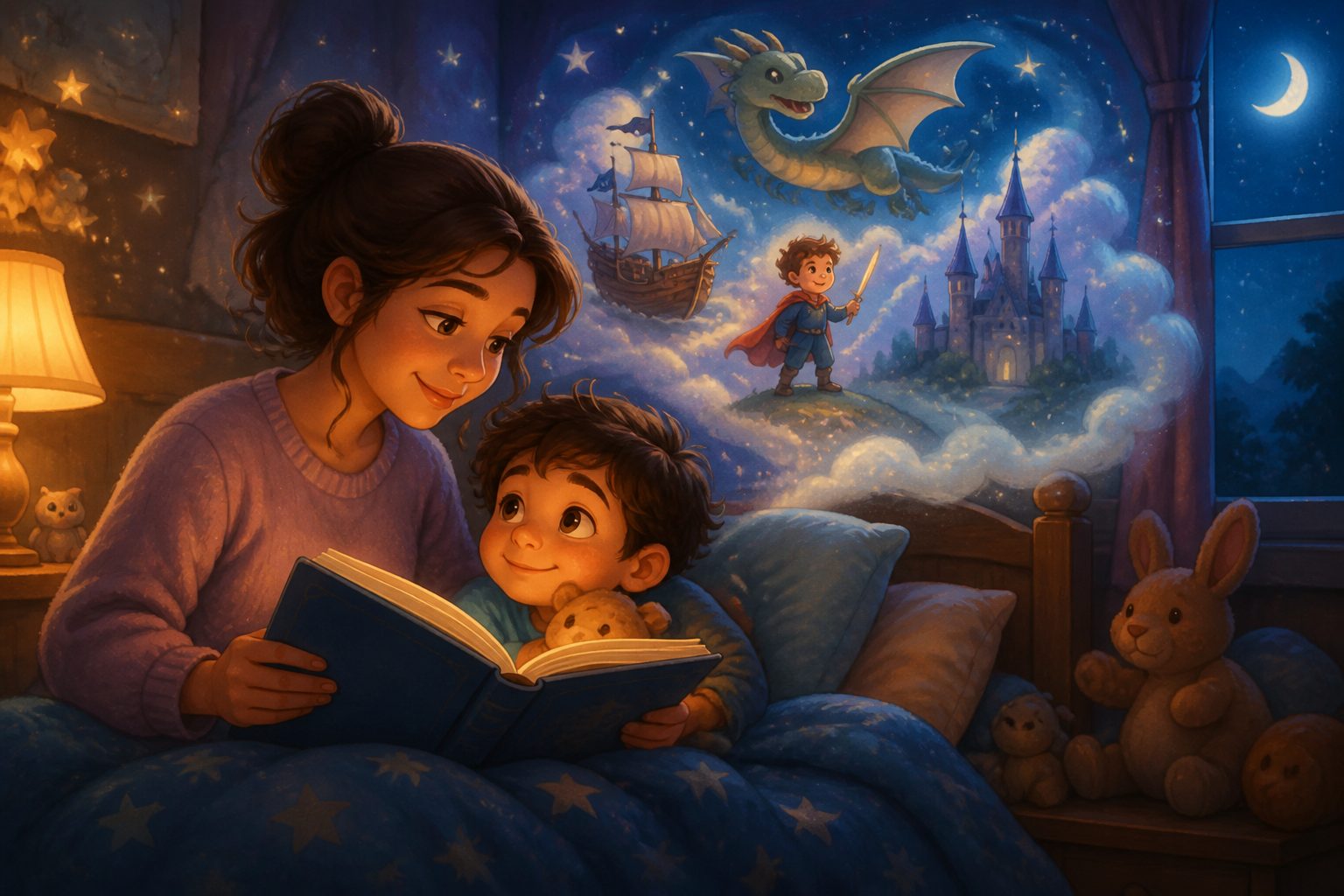
To make a personalized bedtime story, start with your child's name, one familiar detail, and a small task that can be finished. A favorite toy looking for its missing ribbon is enough of a plot. You can add imagination without inventing a whole world or making the story a lesson about your child's day.
At a glance: Choose a hero, a recognizable detail, a manageable problem, and a clear ending. The five prompts below are ready to adapt. Review the finished story before reading it, and choose a length that fits your evening.
A simple story recipe
Use four ingredients:
- The hero: Your child or a character they choose.
- The familiar detail: A toy, phrase, pet, or place they recognize.
- The task: Find, mend, deliver, prepare, or choose something.
- The ending: The task is finished and the characters have somewhere to rest.
For example: “Noor and her toy rabbit find the ribbon for a small parcel, deliver it to Grandma, and return home.” The personal detail is the rabbit; the plot is the delivery. You do not need to mention every member of the family for the story to belong to this child.
Five personalized bedtime prompts
1. The garden gate's little key
Write a gentle picture-book story about [name] and [favorite toy] finding the key to a garden gate. Include [familiar flower or object]. They check three sensible places, find the key in a coat pocket, and close the gate for the evening. End at home. Keep the mystery small and resolve it completely.
Adapt it: For a short version, check two places. For a child who likes clues, make the coat pocket visible in an early picture.
2. The pajama train's final stop
Write an imaginary story starring [name] as a passenger on a small toy train that becomes big enough to ride. The train delivers cushions to two friends and returns to [name]'s room. Include [favorite pajama pattern]. Give the conductor a kind, funny line and finish with the train back on its shelf.
Adapt it: Choose the companions your child wants. The train can stay entirely inside an imaginary bedroom landscape.
3. The cloud baker's measuring spoon
Write a fantasy story about [name] helping a cloud baker find a missing measuring spoon. Include [family phrase]. The spoon is beside the recipe book, and they use it to finish one small batch of imaginary cloud biscuits. End with the counter tidy and the baker hanging up the apron.
Adapt it: Make the mistake easy to follow. Do not claim that eating the biscuits produces sleep or special dreams.
4. The museum of tiny treasures
Write a picture-book story about [name] arranging three treasures on a shelf: [object one], [object two], and [object three]. A friend helps make labels. They decide where each object belongs and close their little museum for the night.
Adapt it: Use ordinary objects with a family meaning. The story can explain one memory per treasure without sharing private information.
5. The pet's reading corner
Write an imaginary story about [name] making a reading corner for a pet named [pet's name]. Include [familiar blanket or cushion]. The first arrangement is too crowded, so they move one object and make room. End with the corner ready and a book chosen for tomorrow.
Adapt it: The pet may speak in the story. Keep that clearly part of the fantasy, and use activities you would be comfortable with the child imitating.
Make the personal details useful
A detail works best when it has a job in the story. A striped scarf can mark the right coat pocket. A favorite phrase can become the conductor's announcement. A toy can carry a clue or ask a question.
Avoid a long list of names that never affect the plot. Check that objects stay the same color and that the hero makes a choice rather than watching other characters do everything.
If the story touches on a real worry, keep it gentle and avoid telling the child how they must feel. You can let the character ask for help or change a plan without making a promise that the same solution will work in real life.
Adjust the reading format
| Tonight's preference | Try this adjustment |
|---|---|
| Pointing and talking about pictures | One familiar scene and brief text per page |
| Listening to a complete tale | One task with a beginning, middle, and ending |
| Taking turns reading | A repeated line the child can choose to read |
| Enjoying a small puzzle | Two or three clues with a resolved answer |
| Returning to a favorite | Keep the plot and change only one detail |
Follow your child's response. A child who asks for the same story again does not need a fresh one every night. NAEYC's guidance on reading with toddlers emphasizes conversation and familiar books over drilling.
Keep the evening routine broader than the story
Decide on a book or stopping point before reading. Leave room for a question, and shorten the tale when time is limited. For general guidance, see the AAP's Brush, Book, Bed routine.
A personalized story is a creative reading choice. It does not guarantee less resistance, slower breathing, or a particular sleep outcome.
Create, review, and keep the story
Start with one of these prompts. Use the character guide if you want to build the cast, then read the draft aloud and examine every illustration. Correct names, remove unsuitable scenes, and check that the ending is complete.
Consult the AI storybook safety guide and privacy policy before providing family details.
If you want a physical copy, Storywish prints softcover picture books. Add a dedication and review the pages through the printing walkthrough.
Frequently asked questions
What should I include in the prompt?
Name the hero, one or two personal details, the task, and the ending. Add the reading level or desired length when relevant.
Do I need a new story every night?
No. Reread a favorite, tell a short variation, or choose another book from the shelf.
What if the generated story feels too busy?
Reduce the cast, remove a subplot, and ask for one small problem with a clear solution. Review the revised version before sharing it.
Want to make your own personalized AI children's story? Try Storywish free.
Related posts
Dragon Bedtime Story: Gentle Tales for Sleepy Nights
August 27, 2026 · Read an original dragon bedtime story about the last pillow, then explore simple story ideas and ways to create a personalized softcover picture book.
The Best Bedtime Story Ideas for 6 Year Olds
August 28, 2026 · Find bedtime story ideas for six-year-olds, plus an original tale to read aloud. Choose a theme, adapt it to your child, and create a personalized story.
Bedtime Story for 3 Year Olds: A Gentle Guide
August 27, 2026 · Read two short original bedtime stories for three-year-olds. Find simple adaptations, book selection ideas, and guidance for sharing a personalized tale.

Beach Bedtime Story Ideas for Calming Evenings
August 26, 2026 · Read three short beach bedtime stories about a sandcastle, a tide pool, and a lighthouse. Add family details or create a personalized softcover picture book.